
Search
Search
1448 results were found.
5. Old shingles around the perimeter of the roof window must be re-nailed. A new nail should be nailed next to the place and glued with bituminous mastics.

6. The new roof skylight in a shingle roof after reconstruction
Remember: The replacement of your old skylight may not be a difficult job. However there is always a possibility of making a small mistake, resulting in a leakage problem. Therefor the best timing to replace your skylights is when you are renovating your roof. You’ll save money in the long run and ensure you won’t be paying for a new roof twice!

Interested in the product mentioned in this blogpost?


Dormers with a roof slope of less than 9,5 degrees on a shingles roof
If you want to get more space and light into your house, then you can build up a dormer on your roof or add a winter garden to the outer wall of your house. Dormers avoid the potential valleys that will be created. Usually these solutions have very low sloped roofs. Sometimes these slopes are even less than 9,5 degrees, making them not suitable for standard roofing materials. Roof parts such as valleys, very flat curved parts or low slope inclinations might all be dangerous spots for driven rain and water, snow accumulation and ponding water.
To have all of these details 100% secure, IKO launched a unique solution: the installation of the “Thermo-adhesive system” in combination with IKO bitumen shingles (nailing not required).
In this blog post you will find out how to install IKO Shingles on dormers with a low roof slope.
Shed dormer with a low sloped roof >>>

Basic types of dormers


Your IKO solution for low slope dormers = IKO Shingles Thermo System
Roof Shingles can be installed on any shape of roofs with a minimum roof slope of 15°
(with Cambridge Xtreme 9,5° you can go to a minimum 9,5°).
What if you have a roof part or dormer which has a very low roof slope between 4° to 15°?
Does it mean you have to use a different roof material instead of shingles for that part of the roof?
Does it mean you need to choose 2 different roof materials for your house?
Absolutely not!!
With IKO Shingles Thermo System you overcome the technical challenges of the low slope dormer and
finish your dormer also with professional IKO Shingles.
Your complete roof covered with 1 esthetical solution and you can choose any favorite shingle from the complete professional IKO Shingles range.
Beneath, we will focus on low sloped wooden deck application with regards to dormers.
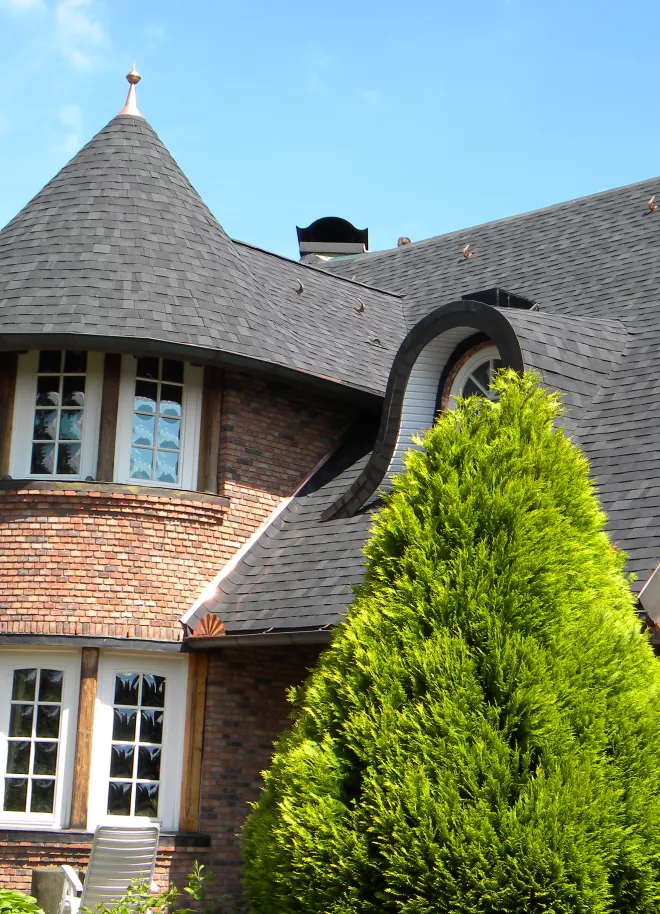
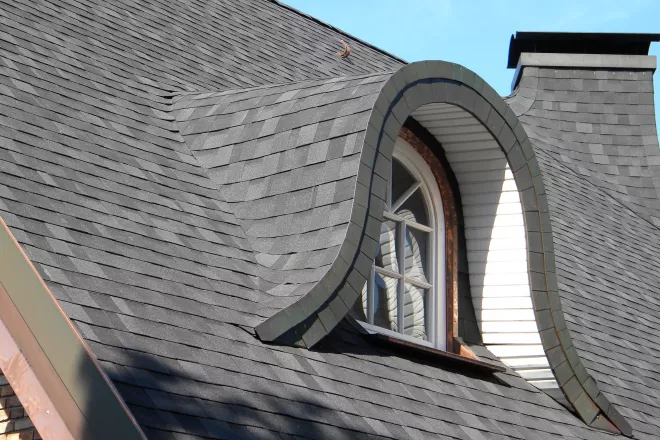
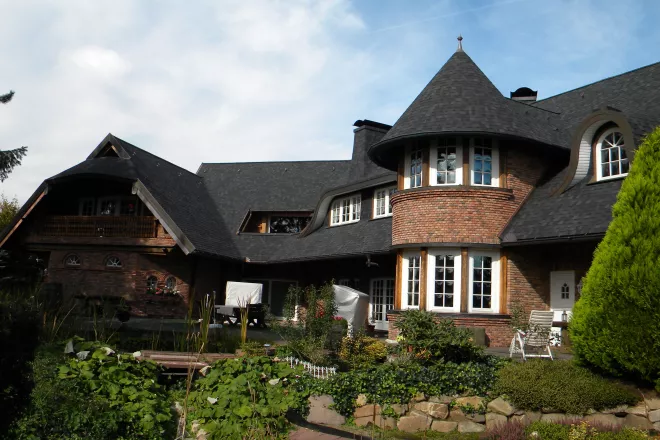
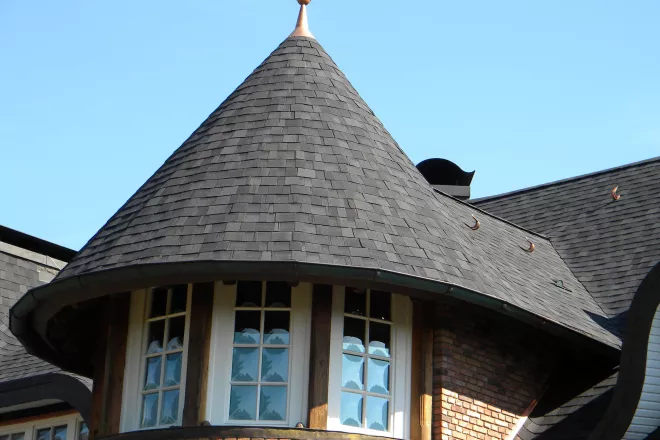
Reference project in Germany: IKO Cambridge Xpress, color 52 Dual Black
How to apply shingles on low slope dormers?

Red roof parts = low slope dormer parts
(before IKO Thermo System installation)

